The Insurrection Act, explained
- November 26, 2025
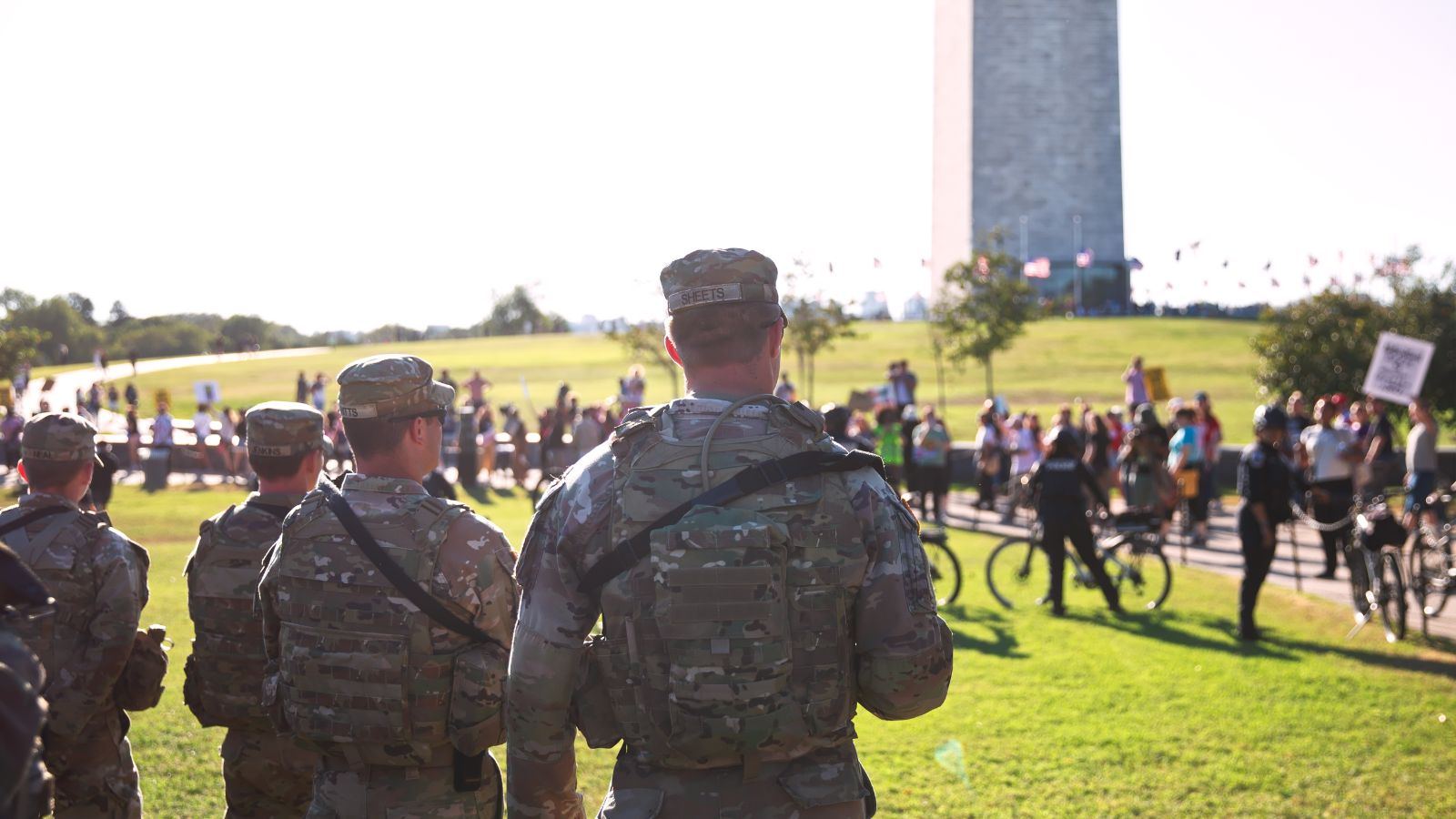
A central hallmark of American democracy is that, with tightly limited exceptions, the U.S. military is not used here at home. Since the earliest days of our republic, Congress has passed statutory constraints on domestic deployment that go beyond what is required by the Constitution, intended to prevent the chief executive from abusing the awesome power of the military — overseas and, especially, on American streets.
However, this tradition has been tested by multiple federal and state deployments of the Marines and National Guard across the country under the second Trump administration, and President Trump has publicly mused about invoking the Insurrection Act to enhance his ability to deploy troops on American soil.
Read more: Understanding the National Guard Read more: Understanding the National Guard
The Insurrection Act
Under the Posse Comitatus Act, members of the federal armed forces are barred from participating in civilian law enforcement activities unless doing so has been “expressly authorized” by Congress. The Insurrection Act of 1807, which replaced a similar law from 1792, is one of the key exceptions to that law.
The Insurrection Act permits the president to use the federal military domestically to suppress “any insurrection, domestic violence, unlawful combination, or conspiracy,” or when state and federal law enforcement are unable or unwilling to enforce federal law and the U.S. Constitution. Historically, its use has been limited to severe instances of civil unrest — the Civil War, Reconstruction, and certain violent incidents during the Labor Movement — and to defend the rights of marginalized groups, such as during the Civil Rights Movement. Troops deployed under these circumstances are allowed to directly perform civilian law enforcement actions like making arrests, detaining citizens, and enforcing court orders.
However, the Insurrection Act does not suspend the Constitution, impose martial law, or exempt the military from following all applicable state and federal laws. Troops deployed under the Insurrection Act would still need to respect First Amendment rights and civil liberties.
Want more Democracy Insights?Subscribe to our weekly newsletter
The history of the Insurrection Act
The Insurrection Act has rarely been used and then, only in moments of real crisis.
In keeping with our federalist system, the original version of the law was focused on giving the federal government military tools to assist in the event of an insurrection against a state government. Following the Confederate attack on Fort Sumter in 1861, President Abraham Lincoln invoked the Insurrection Act to send troops into seceding states during the Civil War. Congress ratified his actions and amended the Insurrection Act to authorize the president to federalize state militias and use the regular military to suppress any rebellion and enforce U.S. law.
The end of the Civil War did not bring peace; white supremacists continued to engage in violence against Black Americans and insurgencies against the federal government to impede Reconstruction in the South. Following President Ulysses S. Grant’s election, Congress again amended the Insurrection Act to add the authority to invoke the Act when “any part or class of people is deprived of a right, privilege, immunity, or protection named in the Constitution and secured by law.” Grant invoked the Insurrection Act six times to put down Ku Klux Klan and other white supremacist violence. In the 20th century, Presidents Dwight D. Eisenhower and John F. Kennedy used the Insurrection Act to enforce desegregation in the South when state and local leaders refused to uphold the U.S. Constitution.
Contrary to President Trump’s claims that “50 percent” of American presidents have used the Insurrection Act, these examples demonstrate the high bar for its invocation in the past. Only 17 of our 45 presidents have invoked the law, and on only 30 occasions. It hasn’t been used in more than 30 years — the last five presidencies. It’s an exception to the rule for a reason: our founders and framers came of age as British soldiers prowled the streets bullying and detaining opponents of the king, one of the primary reasons we revolted against British rule. It only ought to be used when normal law enforcement genuinely cannot enforce the law, putting the safety and wellbeing of Americans at risk, or to ensure Americans’ ability to exercise their constitutional rights. It should never be used to suppress our rights.
Need for reform
Last updated over 150 years ago, the Insurrection Act is badly in need of reform. The current statute contains antiquated and ambiguous language that invites questions over the breadth of presidential authority and the role of courts to limit abuses. Unlike earlier iterations of the law, Congress is given no formal role in signing off on these deployments nor are there explicit time restrictions that limit their duration.
Last year, a bipartisan group of experts convened by the American Law Institute recommended a set of principles to govern Insurrection Act reform, and the Brennan Center for Law and Justice has authored a detailed proposal to reform the law in order to prevent future presidential abuse. These commonsense reforms would increase transparency and accountability without unduly impeding legitimate invocations of the law.
Related Content
-

How to stop Trump’s National Guard weaponization
- Stopping the Consolidation of Power
- Research & Analysis
- Explainer
-

Understanding the National Guard
- Stopping the Consolidation of Power
- Legislation & Policy
- Explainer
-

How to reform domestic deployment authorities
- Stopping the Consolidation of Power
- Legislation & Policy
- Explainer
Join Us.
Building a stronger, more resilient democracy is possible, but we can’t do it alone. Become part of the fight today.
Donate
Sign Up for Updates Sign Up for Updates
Explore Careers Explore Careers
How to Protect Democracy How to Protect Democracy