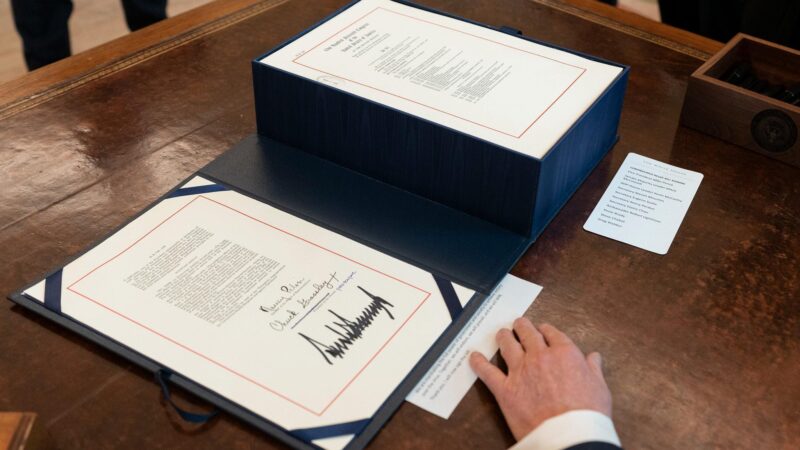
The impoundment threat, explained
Trump’s position is wrong. There is no inherent power to impound. The history of presidential impoundments makes this clear.
The Constitution places Congress at the center of our system of checks and balances. Congress is designed as the most representative branch of government. Alongside its core legislative function, Congress holds the power of the purse, the authority to confirm executive and judicial appointments, the power to investigate and oversee the executive branch, and — as a last resort — the power to impeach. These are not procedural details. They are the primary mechanisms by which the American people, through our elected representatives, set national policy and hold our government accountable.
Those mechanisms are under strain from three directions at once. The executive branch has asserted sweeping powers that encroach on Congress’s constitutional turf — withholding funds Congress appropriated, dismantling agencies Congress created, ignoring laws Congress enacted, and stonewalling oversight requests. The Supreme Court has routinely gutted key acts of Congress aimed to structure and safeguard our democracy, such as the Voting Rights Act and criminal laws that apply to the executive branch. And Congress itself, particularly when controlled by the same party as the president, has too often stood aside rather than fulfill its constitutional role. When these failures occur simultaneously, the result is an executive branch that operates without meaningful checks.
Trump’s position is wrong. There is no inherent power to impound. The history of presidential impoundments makes this clear.
Under the Constitution, Congress holds the power of the purse. The president’s role in federal spending is simply to see that Congress’s spending laws are faithfully executed. If Congress passes a law requiring that certain money be spent, and the president withholds that money, then he has broken the law. The Trump administration has attempted to freeze trillions of dollars in congressionally appropriated funds, which is a direct assault on one of Congress’s most foundational powers.
The weakening of critical oversight mechanisms has steadily diminished Congress’s leverage over the executive branch, leaving congressional oversight to happen largely on the president’s terms. This undermines our constitutionally mandated system of checks and balances. When the majority party in Congress declines to exercise its oversight authorities by avoiding hearings, blocking subpoenas, and deferring to the White House, the constitutional design breaks down entirely.
Congress should act to constrain the aggrandizement of power by an autocrat in the White House. While there is much that Congress should do to check executive abuses of power, a good starting point would be to retake control over emergency powers, so that presidents cannot use these as a pretext for long-term policy change. Similarly, Congress should reclaim its constitutional authority over decisions to go to war. And passage of the No Political Enemies Act (NOPE) will deter weaponization of government against the public and give those targeted by the federal government the tools they need to defend themselves. Together, these two reforms would begin to improve the balance of power between Congress and the White House, building back congressional power that has long been withering.
Building back congressional power will only be possible if Congress works better and, critically, is more representative of the voters. One of the chief problems with America’s legislative branch is a zero-sum polarization, one that can be eased by democratizing the institution and enabling sub-parties to operate inside of both major parties. Reforming the rules of Congress to enable coalitions to form would help spur more movement inside the body. In the long-term, America should also move toward a system of proportional representation for electing members of the House which would make that body more representative of the American people, and also create space for more political parties to emerge. This can work alongside an expanded House of Representatives to create stronger representation.
Explore this work
Former judges and legal experts convene to discuss threats to the rule of law Former judges and legal experts convene to discuss threats to the rule of law
Restoring transparency to OMB apportionment decisions Restoring transparency to OMB apportionment decisions
How we can democratize Congress How we can democratize Congress
Building a stronger, more resilient democracy is possible, but we can’t do it alone. Become part of the fight today.
Donate
Sign Up for Updates Sign Up for Updates
Explore Careers Explore Careers
How to Protect Democracy How to Protect Democracy