Ben Gips is a policy advocate focused on elections and technology governance, working to protect free, fair, and secure elections. He currently leads Protect Democracy's state policy work in California.
California’s vote count, explained
- October 29, 2026
California’s vote counting speed is improving election after election
California is the most populous state in the Union, and every election season, we see dozens of articles about the state’s vote counting process and why it takes so long to call races there. Given the number of elections in the state, we expect that some will be close in the 2026 midterms. For that reason, it could be a focus of the Trump administration’s interference efforts. California has already become a target of interference efforts, including lawsuits based on extreme claims about non-citizen voters with little evidence behind them. But as Election Day nears, we can expect narratives to return to an oft-cited claim: that California counts ballots too slowly. Here’s what you need to know about vote counting in California, and how it’s changed in recent years.
Is California actually slow to count ballots?
Yes and no. When most people think about election results, they think about when a given race is called by the media. The timing of that call is primarily a function of two things: how many of the ballots in the race have been counted, and how close the race in question is.
Of those two things, the only one that election officials can control is the speed of counting ballots. According to data from Sina Shaikh and Charles Stewart III, California was among the top ten states in terms of the percentage of ballots reported immediately after polls closed in 2024. By later benchmarks such as a week after Election Day, the state had fallen to the bottom of the list in terms of percentage of ballots reported. As Miles Parks recently reported for NPR, California wasn’t alone there either — Maryland reached 95% of ballots counted on the same day as California, and Alaska reached that threshold two days later. So while California may not be a complete outlier, there is clearly work to do.
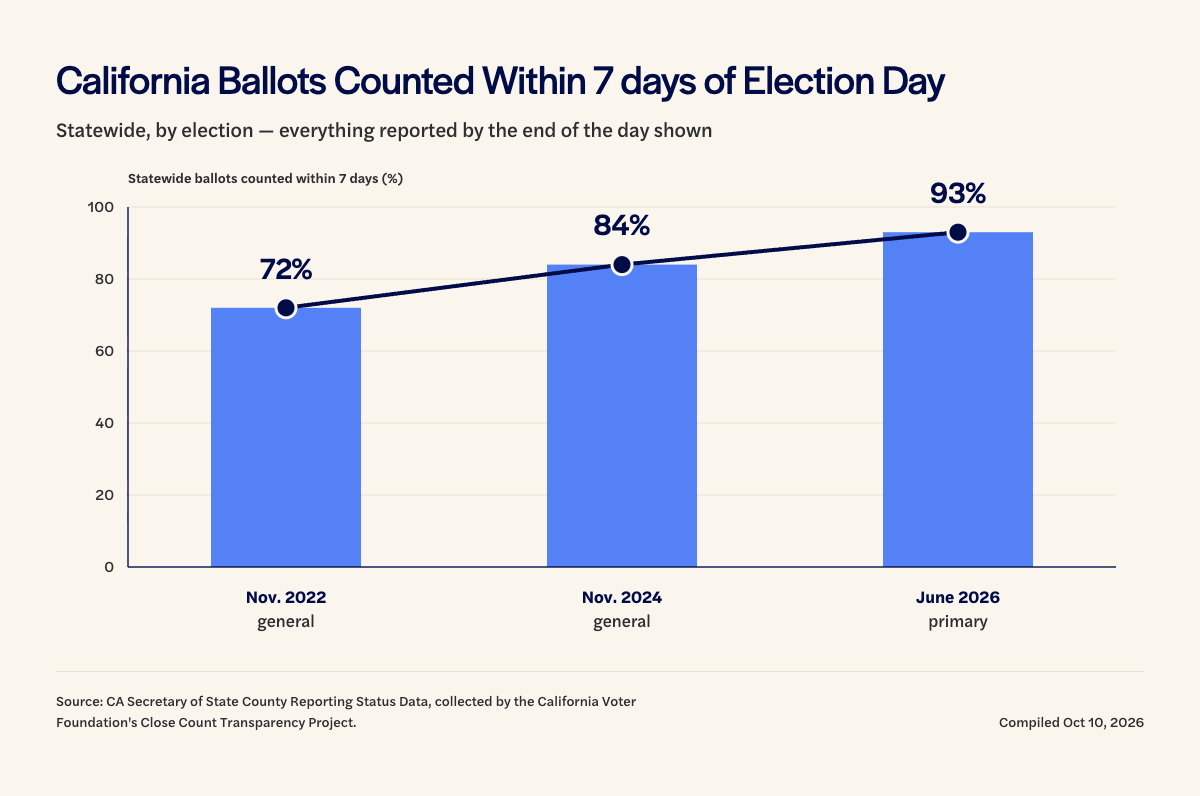
At the same time, there’s reason to be encouraged. California is speeding up its ballot counting. The chart below compares a primary to recent general elections, so it isn’t apples-to-apples, but the trend is clear. We’ll come back to what’s driving that progress and what comes next, but first, it’s worth understanding why calling races in California takes as long as it does.
So why are California’s races so often the last to be called?
Many of us remember recent election cycles when control of the House of Representatives has come down to a few seats in California, and races weren’t called for over a week after Election Day. There are several reasons why that is the case:
California makes it very easy to vote; some of those policies can extend the amount of time it takes to count ballots. Over 80% of the state’s voters typically vote by mail, and mail ballots take more time to process since they must be checked for problems, opened, removed from envelopes, and scanned. Other policies that extend the processing timeline include the seven-day grace period for mail ballots, extended windows to cure ballots with signature issues, same-day registration, and a requirement that ballots returned to an incorrect county in California be redirected to the correct county. In addition to these vote by mail safeguards, California offers voters robust options to vote in-person, which can strain the resources of election officials asked to run both systems well. States like Oregon share many of these policies, which is why their speed of counting ballots is comparable.
California’s top-two primary system often leads to close races in both primary and general elections. California also has an independent redistricting commission that has created several highly competitive districts. While Proposition 50 temporarily removed House of Representatives districts from the commission’s control, other races continue to be determined by the commission. When a race is exceptionally close, like the 2024 CA-13 race that came down to 187 votes out of the over 210,000 cast, counting will necessarily continue until the statutory deadline for certification. As noted above, California sets this deadline late to allow voters plenty of time to cure any issues with their ballots.
This one is obvious, but for the state-wide races, in particular, it is worth emphasizing. California has more votes to count than anyone else. The large population also creates a simple math problem: About 12% of the House seats in the country are in California, more than any other state. If we assume all races are equally likely to become exceptionally close (like the CA-13 race mentioned above), basic intuition tells us chances are higher that we will see one in California than anywhere else in the country.
The most time-consuming ballots to count are those that are returned in a vote by mail envelope on or immediately before Election Day, since each must be sorted, inspected, and signature-verified after polls close. In recent elections, this category of ballots has been around 25% of all ballots cast, or more. This creates a “pig in the python” effect where election officials must process a major glut of ballots on and after Election Day. Much attention is also paid to ballots that are mailed on Election Day and arrive within the seven day grace period — these are also time consuming, but are typically a much smaller group of ballots (less than 3% of ballots cast in 2024).
California has 58 counties that vary in many ways. As of May 2026, Alpine County California has 930 registered voters, where Los Angeles County has 5.9 million. This level of variance between counties means that each county uses its own approach to vote counting, and makes statewide process improvements challenging. Slight differences also compound other items on this list: For example, early voting opportunities available to voters vary across counties, making statewide messaging on voter behavior difficult.
The state does not regularly provide funding for elections in California, in large part due to a broken state mandate reimbursement process. This means counties are typically on their own for providing all aspects of election administration, including capital costs. Poorer counties tend to lack the equipment, space, and staff needed to count ballots quickly, leading to some counties counting ballots substantially faster than others.
In sum, the frequent spotlight on California’s ballot counting is partly because of its status as the largest state and because it’s home to many close races, and partly because of policy choices that emphasize broad voter access and comprehensive ballot verification.
What is California doing about it?
The good news is that California is making progress on speeding up ballot counting while protecting voter access and election security. As we saw in the chart above, this is already visible in the data.
California isn’t stopping with that progress, however. The state allocated $40 million to “safeguard” and “speed up” ballot counting, in an investment Protect Democracy pushed for alongside the California Voter Foundation. This effort includes designating some funds specifically to voter outreach, hoping to shrink the proportion of ballots delivered in envelopes on Election Day that are time-consuming to count.
We also partnered with UC San Diego’s Center for Transparent and Trusted Elections and San Joaquin County Registrar Olivia Hale on a randomized experiment ahead of the June 2 primary, sending 34,346 voters two “Don’t Delay, Vote Today!” postcards. The results were statistically significant: Recipients returned ballots 0.4 days earlier on average and were two points more likely to meet the recommended deadline for election-night counting. This despite the statewide context of many voters returning mail ballots at the last minute due to an unsettled primary for governor.
California has made significant progress on the legislative front as well. The June primary was the first time that election officials in California faced a new 13 day deadline to count all ballots, with specific exceptions. Two bills we co-sponsored with the California Voter Foundation, both of which were recently signed into law, aim to build on this progress:
- SB 1420, authored by State Senator Laura Richardson, directs the Secretary of State to provide implementation guidance and voter education for “Sign, Scan, and Go” voting — bringing a completed mail ballot to a polling place, signing in as an in-person voter, and casting it on the spot. This voting method has shaved days off of ballot processing in some counties, and can build voter confidence by allowing voters to be sure their ballot won’t be rejected.
- AB 2604 from Assemblymember Marc Berman, focuses on extremely close races and gives every county access to an “electronic signature curing” tool that lets voters whose ballots face issues in the signature review process submit an updated signature from their smartphone rather than returning a slower mailed document. It will be implemented for elections following the 2026 general election.
Through these efforts, California is proving that speed of counting and ease of access do not have to be in conflict.
Counting could be faster, but it’s evidence of a thorough effort
Every election cycle, California’s slow vote counting process is used to support claims of fraud. There is simply no evidence to support these claims. California elections take time to finalize because of the factors described above, as well as security measures the state has in place to keep elections free and fair like individually comparing voter signatures on millions of mail ballots. While California vote counting could be faster, those who point to its slowness as evidence of malfeasance is not basing their claims in any evidence.
So what comes next?
Work remains for California to continue building on its ballot counting progress. Election administration needs to be an ongoing budget priority for the state so that counties can depend on the state to support ongoing and recurring costs in addition to one-offs. This year’s $40 million was real progress, but fixing that funding gap for good is arguably the single highest-leverage action California could take before 2028.
There is also the question of timelines. Mail ballots postmarked by Election Day can arrive and count up to seven days later, and voters have up to 22 days to fix a signature problem before their ballot is rejected. Alongside partners in the state, we are studying whether either window could be shortened without hurting voters, since it’s an open question how much of that time is actually being used versus just adding to the count.
But the most important next step of all lies not with the state, but with the voters. Every California voter can do their part to help ensure races can be called as quickly as possible:
- Use an official ballot dropbox! Putting your ballot in a dropbox gets it directly to election officials, instead of it having to go through the mail. You should still aim to vote as early as you can, ideally by the Friday before Election Day.
- Vote in person! California offers a range of in-person voting options, and you can check out your county elections office website for details. One option that’s available statewide for the first time this year: at least six hours of early voting on the Saturday before Election Day at your county elections office. In 2026, that’s Halloween! Make sure to cast your ballot before heading out to trick or treat!
- If you vote by mail, vote early! As soon as you’ve made up your mind, fill out your ballot and send it back to election officials in your county. Now that we are less than one week to Election Day, you should use an official drop box or turn in your ballot at a polling location rather than the mail if at all possible.
About the Author

Related Content
-
Tracking retaliatory use of arrests, prosecutions, and investigations by the Trump administration
- Stopping the Consolidation of Power
- Research & Analysis
- Analysis
-
Protecting voter privacy and the integrity of U.S. elections
- Protecting Elections
- Litigation
- Case Documents
-
Frequently asked questions about the 2026 midterm elections
- Protecting Elections
- Research & Analysis
- Explainer
-
What to do if you face intimidation at the polls
- Protecting Elections
- Research & Analysis
- Toolkit
Join Us.
Building a stronger, more resilient democracy is possible, but we can’t do it alone. Become part of the fight today.
Donate
Sign Up for Updates Sign Up for Updates
Explore Careers Explore Careers
How to Protect Democracy How to Protect Democracy