President Trump’s corruption, explained
- September 14, 2026

In 2025, President Trump made $2.24 billion while serving as the country’s most important public official. That kind of profiteering is a remarkable outlier in the history of presidential politics. Jimmy Carter, quite famously, put his peanut farm in a blind trust to avoid the appearance of conflicts of interest. In contrast, President Trump and those around him have consistently blended together the work of government with personal financial interests.
That corruption is also part and parcel to the president’s broader authoritarian project. Autocrats all over the world have profited from their offices, and personal profit is one reason they are so determined to entrench themselves in power. Even elections where Trump is not on the ballot suddenly become crucial – the president’s allies in Congress have given the president a free pass to continue making money off of the office, and he wants to avoid the accountability that could come if his allies lose their seats.
The president’s corruption, then, can be directly connected to his election interference efforts, and his broader work to consolidate power.
The two kinds of corruption
Two types of corruption often emerge in authoritarian states: enriching corruption and entrenching corruption. Enriching corruption directly benefits the autocrat, while entrenching corruption is primarily designed to keep them in power. As Conor Gaffney explained to a congressional subcommittee in 2025:
To illustrate the distinction between enriching corruption and entrenching corruption, consider two kinds of corrupt practices. In Kenya, the practice of kickbacks is pervasive, where public funds are regularly siphoned by officials of many political parties and redistributed locally to supporters. In Turkey, zoning changes and non-competitive contract procurement have been used by leaders of Erdoğan’s Justice and Development party (the ruling authoritarian party) to co-opt opposition figures and parties.
Brendan Carr’s FCC campaign against ABC and other media outlets is straightforwardly entrenching corruption. The profits that Trump and his family have made from cryptocurrency, on the other hand, is enriching corruption.
These corrupt practices can reinforce one another
What we’re seeing from the Trump White House is not just corruption across multiple fronts, though. Trump’s corruption is a closed circuit of money and power. Government power is leveraged for private benefit, which in turn helps consolidate power over the government.
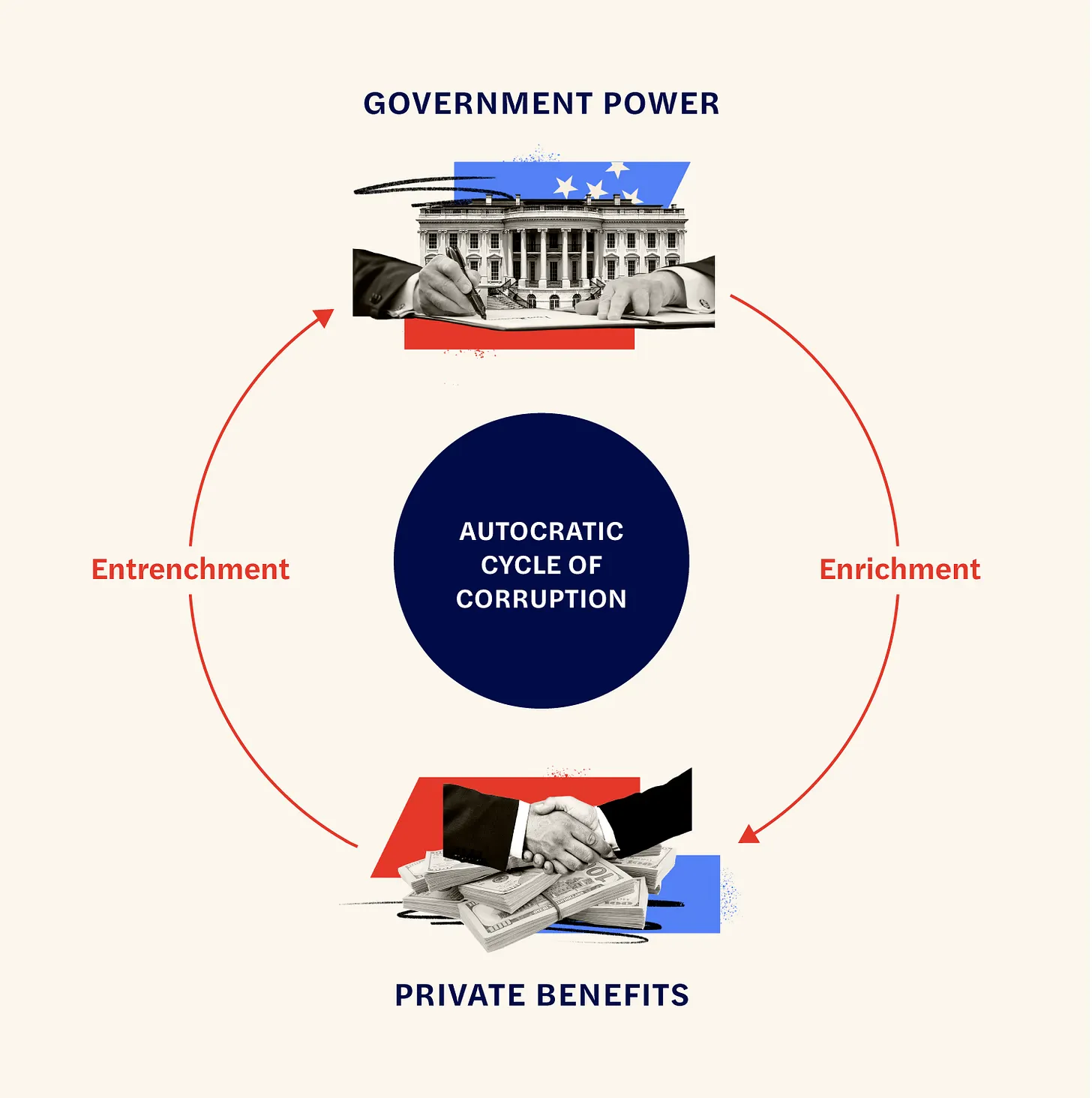
There’s a four-step process connecting enriching corruption with entrenching corruption:
- Government power and resources — As president, Trump asserts broad regulatory and enforcement authority over a range of markets both in the U.S. and around the world, and seeks to influence everything from who receives a pardon to how regulated a particular industry is and from who gets a contract to who is subject to enforcement for wrongdoing. That power gives him leverage.
- Enrichment — The president then uses that leverage as a path to personal enrichment. He can take a jet from the Qataris and try to convert it for private use, or make private money from his crypto firm (World Liberty Financial) and cryptocurrency ($TRUMP) by deregulating the industry or making favorable deals with other firms.
- Private benefits — This enrichment leads the president and those around him to inordinate profits. Last year, the president made $1.44 billion from cryptocurrency alone (more than half of the $2.2 billion he made in 2025). That’s on top of the money his family is making in industries where the government is a primary decision maker, like defense and tech. The president is running the government and profiting off it as an individual at the same time.
- Entrenchment — The president solidifies his relationships with private actors who are also profiting off of these arrangements, and they, in turn, work to keep him in power. The crypto industry alone represents about 40% of corporate election spending this year.
This cycle shows up in a wide range of examples. Thankfully, though, there’s something we can do about it.
What is autocratic capture? What is autocratic capture?
There’s a way to have accountability and get the money back
Corruption goes hand-in-hand with authoritarianism all over the world. It’s part of why autocrats want power, and it’s also how they keep it. Elections are the ultimate check on corruption, and ours are still mostly intact. If our elections remain free and fair, and new leaders come to power interested in fighting corruption, they’ll still need a vehicle to do so.
Some of the traditional remedies that other countries have relied on, like criminal prosecution, might be difficult to pursue in light of the Supreme Court’s immunity ruling in Trump v. United States and abuses of the pardon power. There are still ways to seek accountability for corruption, though. We can use existing laws — ones that are already on the books — to simply get the corrupt money back.
Specifically, two types of legal remedies, disgorgement (government seizure of fraudulent gains) and civil asset forfeiture (seizure of property connected to criminal activity), are uniquely suited to breaking up corruption retroactively.
By preparing now, civil litigators, forensic accountants, and investigators can build the framework to target the most flagrant areas of self-enrichment, which could include:
- Reviewing massive contracts awarded to insiders and family members.
- Tracking down and clawing back cryptocurrency profits built on non-public, insider government information.
- Ensuring that political allies or rioters who have or will receive taxpayer-funded payouts for unlawful acts do not get to keep a single cent of that money.
- Auditing and recovering high-value foreign gifts and emoluments received by officials that legally belong to the public.
- Investigating pay-to-play operations involving the use of public property and exchange of political favors—such as companies involved in building Trump’s ballroom and putting on Trump events.
- Clawing back assets from coercive deals or regulatory settlements weaponized against private entities, such as media companies, universities, or law firms.
- And, of course, auditing and clawing back funds or assets exchanged for corruptly secured pardons, including fees channeled to lobbyists, intermediaries, or shell companies.
At the core of this approach is a simple, American idea: you can’t keep what you stole. The Trump White House is built on various avenues of corruption, but the president and those around him are not entitled to those riches, and there’s real work to be done to get the money back.
Related Content
-

Frequently asked questions about the 2026 midterm elections
- Protecting Elections
- Research & Analysis
- Explainer
-
What to do if you face intimidation at the polls
- Protecting Elections
- Research & Analysis
- Toolkit
-

What to know about efforts to interfere in the 2026 midterms (and why they are likely to fail)
- Protecting Elections
- Research & Analysis
- Analysis
- Explainer
-
Former high-ranking FCC officials call Carr’s intimidation of broadcasters an outrageous attempt to control information
- Stopping the Consolidation of Power
- Campaigns & Coalitions
- Statements
Join Us.
Building a stronger, more resilient democracy is possible, but we can’t do it alone. Become part of the fight today.
Donate
Sign Up for Updates Sign Up for Updates
Explore Careers Explore Careers
How to Protect Democracy How to Protect Democracy