Grant Tudor develops and advocates for a range of reforms to shore up our democratic institutions.
Proportional representation, explained
- September 24, 2026
Proportional representation is an electoral system that elects multiple representatives in each district in proportion to the number of people who vote for them. If one third of voters back a political party, the party’s candidates win roughly one-third of the seats.
Today, proportional representation is the most common electoral system among the world’s democracies.
What makes the United States different?
Subscribe to our newsletter Subscribe to our newsletter
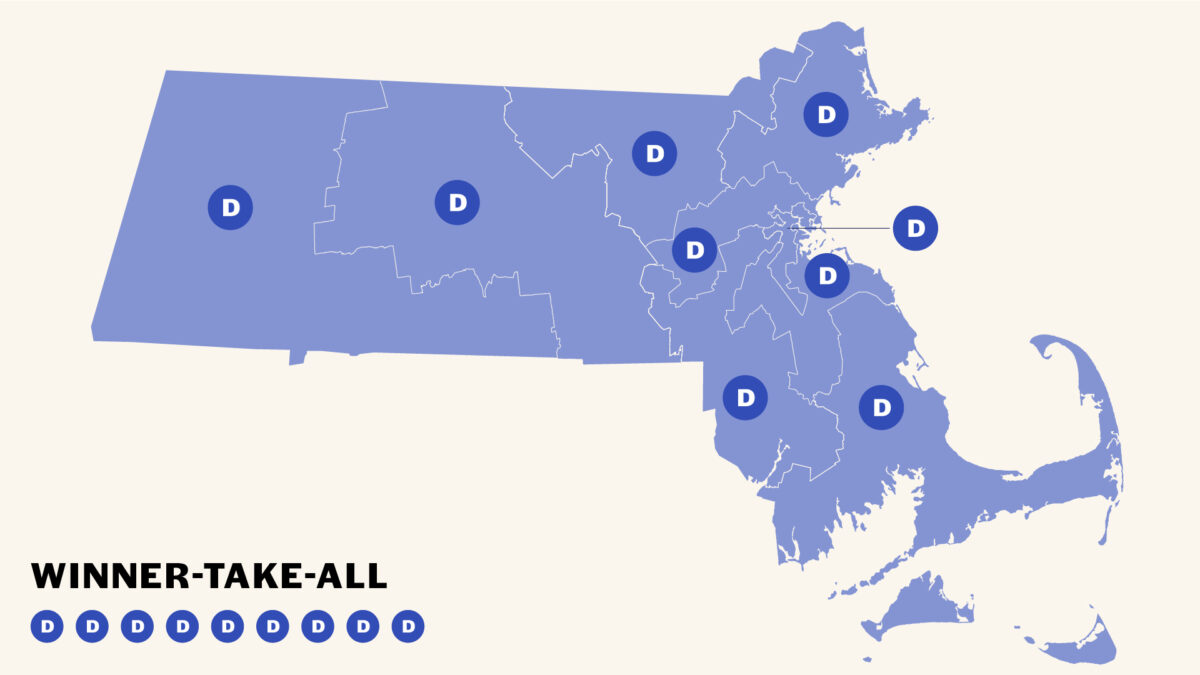
Every American today lives in a district that elects a single representative for congressional and most state legislative elections. Voters cast a vote for a candidate, one candidate wins, and all the others lose. This makes our elections “winner-take-all” — if a candidate wins 51 percent of the vote, she wins 100 percent of the representation. Any voters who did not back the winning candidate are not represented in government by a candidate for whom they voted.
Read more: How proportional representation can end the redistricting wars Read more: How proportional representation can end the redistricting wars
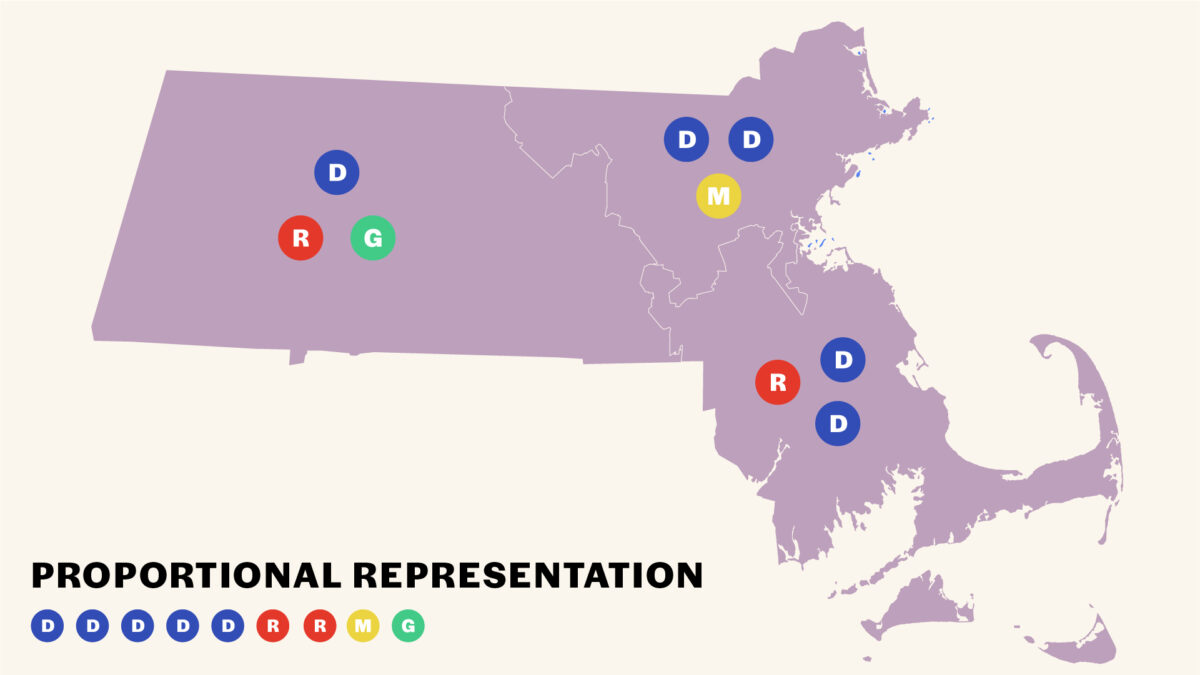
In contrast, proportional representation uses multi-winner districts with representation allocated in proportion to votes. For example, in a six-winner district, if a party’s candidates earn 51 percent of the vote, they would be expected to win three of the six seats — rather than 100 percent. Unlike with winner-take-all, under proportional representation, most groups tend to have at least one elected official representing their viewpoint in government.
The problems with winner-take-all
In highly polarized and diverse societies like the United States, the use of winner-take-all elections can have adverse consequences. Our winner-take-all elections are exacerbating some of the most pressing problems undermining American democracy. These include:
As long as [the winner-take-all system] remains intact, distorted election outcomes will persist. We write to urge Congress to do what most democracies have already done: adopt proportional representation.
Letter to Congress from 500+ Democracy Scholars
The benefits of proportional representation
Our winner-take-all elections aren’t an unchangeable fact — they’re a system design choice, and we have the power to choose a better one. Proportional representation could alleviate many of the problems outlined above and make our democracy more representative and responsive to voters. Today, 20 of the world’s 24 presidential democracies use a form of proportional representation for their elections.
Electoral competition
In a winner-take-all system, most elections are essentially decided before a single vote is cast. By contrast, proportional representation makes nearly every election competitive regardless of where you live. Proportionally electing candidates from multi-winner districts means that no district is “safely” red or blue; instead, parties vie for seats in proportion to their support. Because district lines don’t predetermine results, proportional representation also does away with gerrymandering. Research shows that the more winners elected per district, the harder it becomes to draw biased district lines — and districts with five or more winners are functionally impossible to gerrymander.
Additional resources
-
-
-

What gerrymandering costs voters
- Reports
More parties, better representation
Winner-take-all elections are a root cause of our rigid two-party system. When the first-place finisher in an election wins the sole seat in a district and all other candidates get nothing, additional parties are very likely to split the vote in favor of their least preferred candidate and very unlikely to actually win representation. It’s therefore extremely difficult for smaller parties to form and succeed. On the other hand, proportional representation tends to produce multiparty systems — when groups of voters comprising a meaningful but non-majority share of the vote can win representation, more electorally viable parties can emerge and genuinely compete. And because more communities can elect candidates of choice, proportional representation more accurately represents diverse groups of voters than winner-take-all systems. Proportional systems are associated with more diverse and durable racial representation, as well as more equitable representation for women and young people.
Additional resources
-

Trapped in a two-party system
- Shaping the Democracy of Tomorrow
- Research & Analysis
- White Papers
-

Proportional representation will bring young people into politics
- Building Pro-Democracy Collective Action
- Shaping the Democracy of Tomorrow
- Research & Analysis
- Reports
-
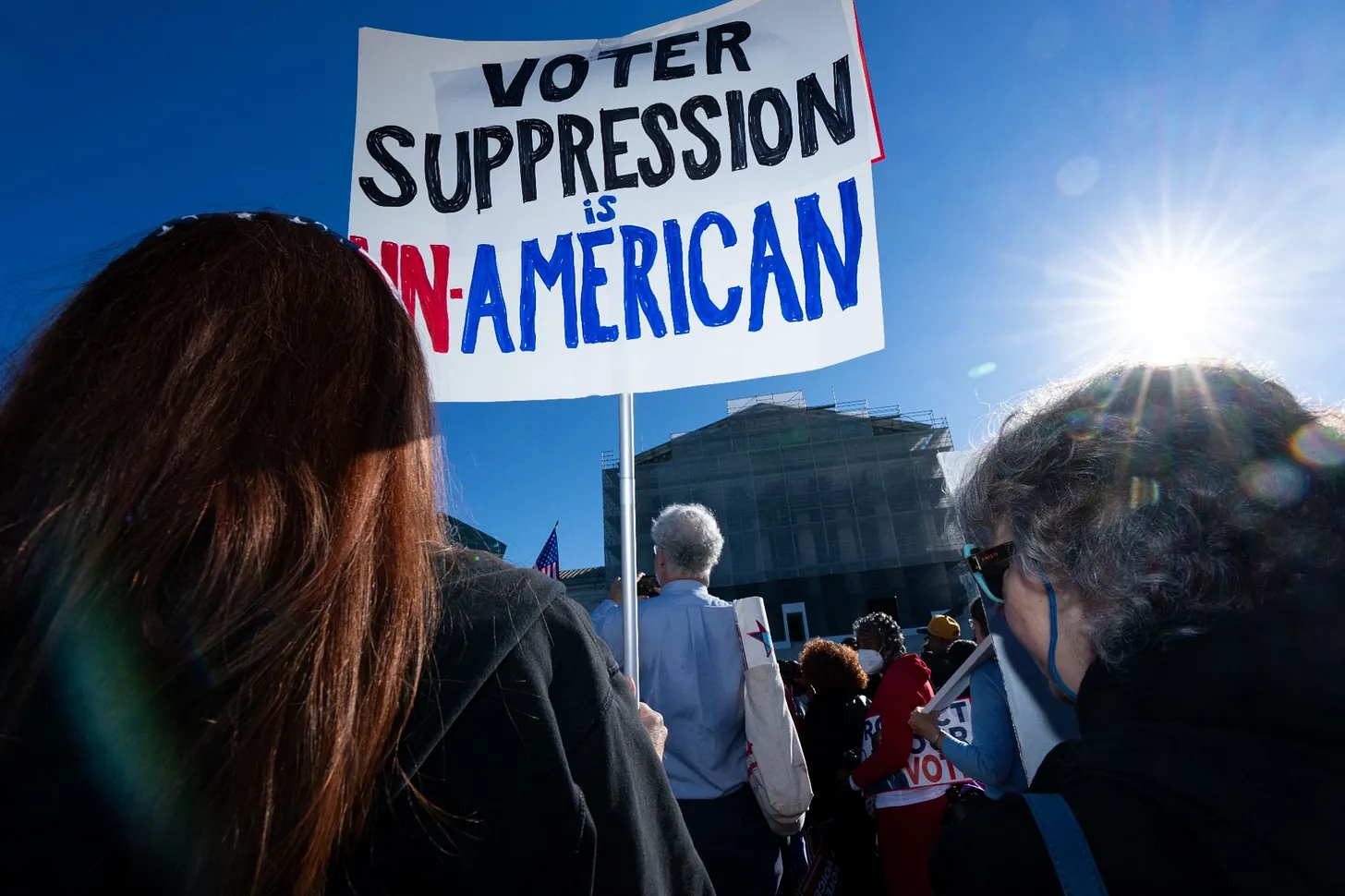
The Supreme Court questions the future of the Voting Rights Act
- Shaping the Democracy of Tomorrow
- Op-Ed
Less polarized politics
Proportional representation helps democracies manage polarization by expanding politics beyond a two-sided, us-vs-them divide. Our rigid two-party system is a main driver of our spiraling polarization — by contrast, proportional representation encourages multipartyism, allowing more viewpoints to be represented and giving parties the ability to evolve, negotiate, and collaborate, rather than eternally fighting a zero-sum battle. By facilitating this power-sharing, proportional representation also lowers the stakes of losing elections. In winner-take-all systems, those who lose are shut out of power and are more likely to turn to violence to influence outcomes, while under proportional representation, parties who don’t come in first place in an election still maintain some voice in government. The result: countries with proportional representation see substantially less political violence.
Additional resources
-

Proportional Representation Could Reduce the Risk of Political Violence in the U.S.
- Shaping the Democracy of Tomorrow
- Op-Ed
-

Proportional representation and polarization
- Shaping the Democracy of Tomorrow
- Research & Analysis
- Analysis
-

Proportional representation and the future of the center-right
- Shaping the Democracy of Tomorrow
- Research & Analysis
- Analysis
-

Proportional representation and political parties
- Shaping the Democracy of Tomorrow
- Research & Analysis
- Analysis
Responsive, effective government
Proportional representation could make government more responsive to voters and ease the gridlock endemic to our two-party system. More viable political parties means more room for dynamic policymaking coalitions to form, as well as more choices for voters, who can more easily hold elected officials accountable when they fail to deliver. As a result, proportional systems outperform winner-take-all systems at achieving policy outcomes in line with voter preferences, especially in highly polarized countries. By ensuring that more voters are able to elect a candidate of their choice, research suggests proportional representation could also allow for more effective constituent services and modestly increase voter turnout.
Additional resources
-

Can proportional representation create better governance?
- Shaping the Democracy of Tomorrow
- Research & Analysis
- White Papers
-
The “goldilocks zone” of political parties
- Shaping the Democracy of Tomorrow
- Research & Analysis
- Analysis
-
Proportional representation: Boosting voter turnout and strengthening democracy
- Shaping the Democracy of Tomorrow
- Research & Analysis
- Analysis
-

Constituent relationships under proportional representation
- Shaping the Democracy of Tomorrow
- Research & Analysis
Varieties of proportional representation
In practice, proportional representation comes in many different forms. Most fit into one of four categories.
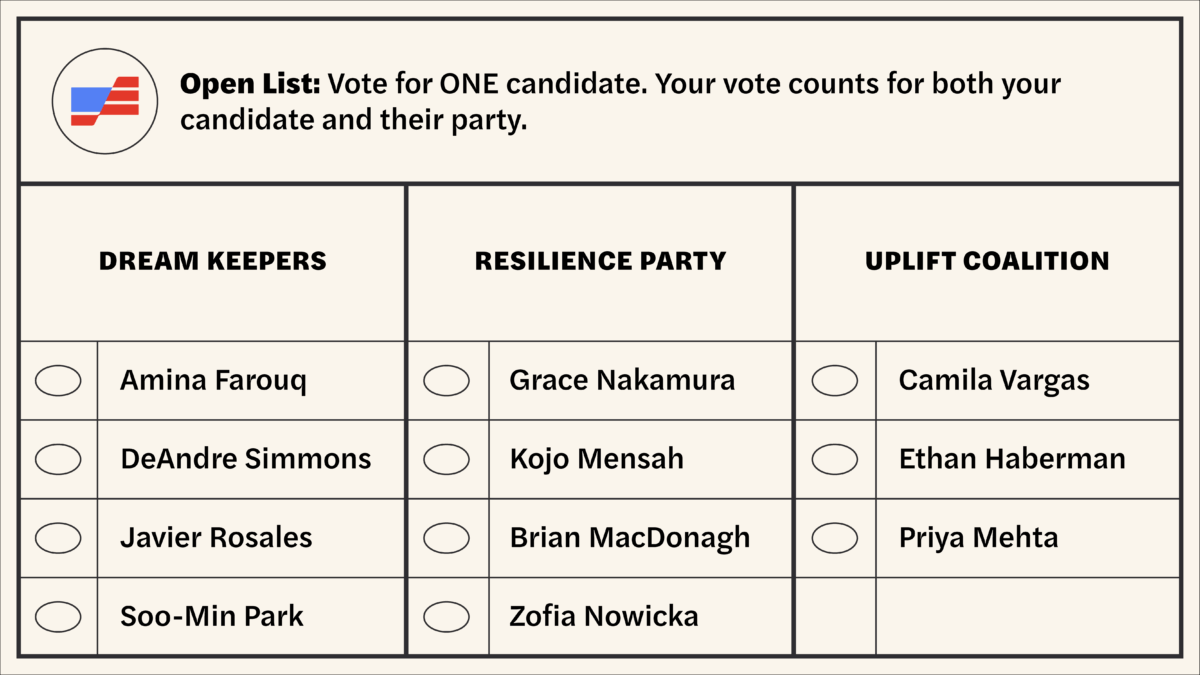
In open list systems, each political party runs a slate of candidates for office (as in a primary election), and voters choose a candidate from a party’s list. Parties are allocated seats in proportion to the total number of votes their candidates receive, and the candidates who receive the most votes are elected. For example, a voter may select one Democrat from a list of Democrats running. In a six-seat district, if the Democrats together win 50 percent of the vote, the three Democratic candidates with the most votes are elected.
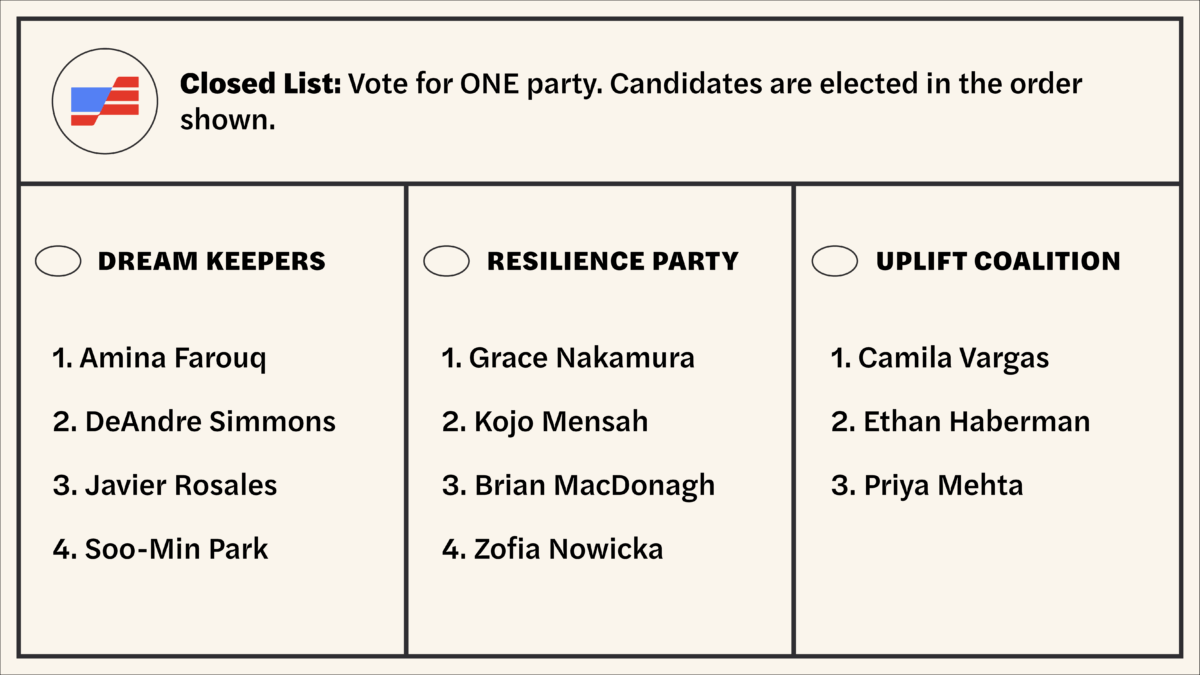
In closed list systems, voters select a political party on a ballot rather than an individual candidate. Parties are allocated seats in proportion to the votes they receive, and parties themselves determine the order in which candidates are seated. For example, a voter may select the Republican Party on the ballot, but not an individual candidate. In a six-seat district, if Republicans win 50 percent of the vote, the party is allocated three seats, and the top-three candidates on the party’s list are elected.
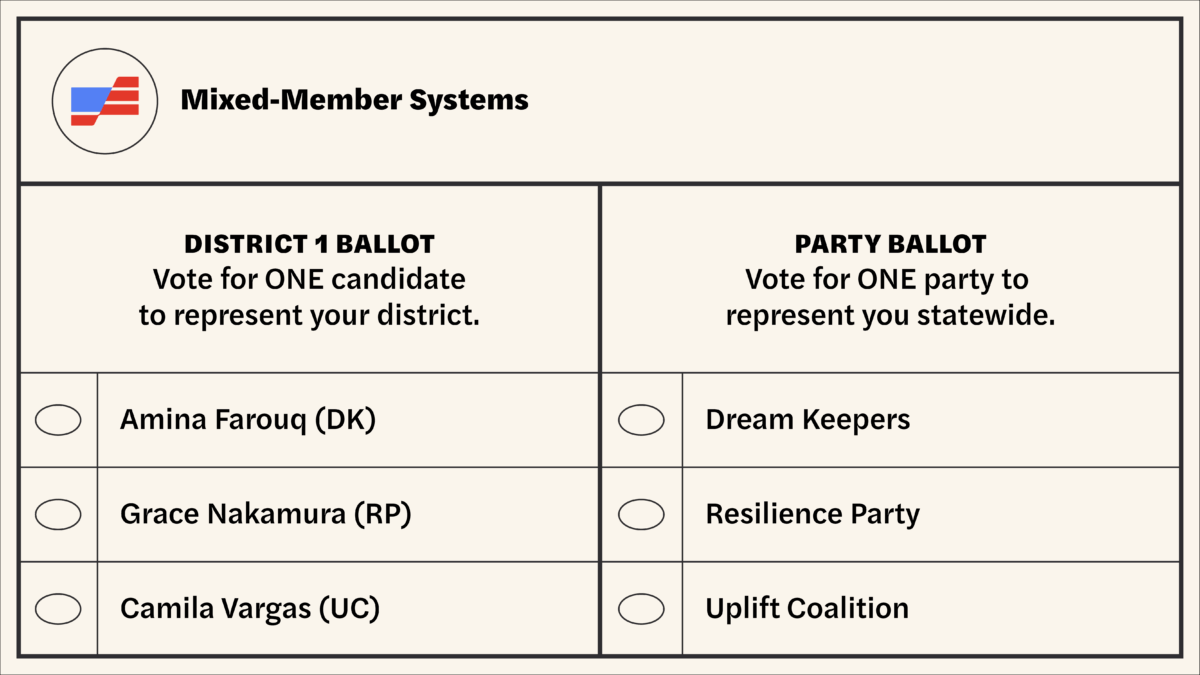
Many countries use systems that blend components of winner-take-all and proportional representation, combining single-member districts with some number of additional seats allocated to parties proportionally. In the U.S., voters could select one candidate for their single-winner district and one party for a set of statewide proportional seats. For example, a given state could have three single-winner districts and three proportional seats. A party that gets 40% of the vote statewide could lose all three single-winner seats but still win one or two of the proportional seats.

Some countries use a system where voters rank candidates, regardless of their party, and the top-ranked candidates are elected. Through successive rounds of ballot counting, votes are reallocated as candidates are either elected or eliminated. This goes on until the seats are filled. For example, if a voter’s first choice candidate comes in last, the candidate is eliminated and the vote is reallocated to the voter’s second choice in the next round of counting — and so on. Additionally, if a candidate gets more than the amount of votes needed to win a seat, the additional votes are also reallocated to the voters’ next preferences.
Frequently asked questions
Is proportional representation connected to ranked-choice voting?
Ranking candidates is a method of voting that is possible under both winner-take-all and proportional systems. While ranked-choice voting and proportional representation are compatible, they are also distinct reforms.
How does proportional representation fix gerrymandering?
The more seats a district has, the harder that district is to gerrymander. Most multi-winner districts are functionally impossible to manipulate for partisan gain. With a lower threshold required to win each seat, voters can no longer be predictably “cracked” between districts or “packed” into one district with any real effect. As gerrymandering becomes more frequent and intense, proportional systems could prevent district maps from predetermining outcomes altogether.
Won’t more parties just lead to more gridlock and chaos?
While certain proportional systems are designed in a way that can generate dozens of parties (which can be destabilizing), most do not. Research finds that modest multiparty activity can lead to more effective governance, while two polarized parties can lead to dangerous levels of gridlock, as well as destabilizing change from one government to the next.
How can this be implemented in Congress?
Adopting proportional representation for the U.S. House is possible through regular lawmaking. Congress could implement proportional representation, or rather, give states the ability to experiment with different versions, through legislation alone. No constitutional amendment is needed.
Can proportional representation work in a presidential system?
Proportional representation is just as common in countries with presidential systems as it is in countries with parliamentary systems. In fact, presidential systems are more likely to use proportional representation for their legislatures, while combining presidentialism with winner-take-all is a rarity found only in four countries (the U.S., Ghana, Liberia, and Sierra Leone).
What about state and local elections?
Any lawmaking body, from national and state legislatures to city councils and school boards, can be elected proportionally. Just like for Congress, implementing proportional representation in state legislatures could increase competition and representation and decrease polarization and antidemocratic extremism. But importantly, it could also encourage the de-nationalization of politics and a focus on more local concerns.
Is large-scale electoral system change politically possible?
While changing electoral systems is politically difficult, it is far from impossible. Indeed, most democracies around the world have changed their electoral systems at least once, if not more. Several notable examples of reform in recent decades — New Zealand, Chile, South Africa, and others — help illustrate how change can happen.
How would proportional representation ensure fair representation for communities of color?
Rollbacks of key Voting Rights Act provisions have eliminated race-conscious districting as a way to prevent racial vote dilution. Moving beyond a winner-take-all system to proportional representation would enable voters of color to achieve fair representation without needing to draw majority-minority districts.
Is proportional representation related to fusion voting?
Fusion voting, which allows multiple parties to nominate the same candidate and “fuse” their support, is distinct from proportional representation and generally is only used with single-member districts. However, the two reforms share many of the same goals, such as making it easier for more parties to form, permitting more options for voters, and enabling more fluid political coalitions.
How would proportional representation impact constituent services?
All voters are, today, already serviced by three legislators: a congressperson and two senators. Research finds that constituent services may improve, as representatives compete with each other to provide better service and voters can select and engage with representatives who best represent their community and interests. Under proportional representation, most voters could contact a representative for whom they voted.
Related content
Fusion voting, explained Fusion voting, explained
Advantaging Authoritarianism: How the U.S. electoral system favors extremism Advantaging Authoritarianism: How the U.S. electoral system favors extremism
Towards Proportional Representation for the U.S. House Towards Proportional Representation for the U.S. House
About the Authors


Related Content
-

Tracking retaliatory use of arrests, prosecutions, and investigations by the Trump administration
- Stopping the Consolidation of Power
- Research & Analysis
- Analysis
-

Frequently asked questions about the 2026 midterm elections
- Protecting Elections
- Research & Analysis
- Explainer
-
What to do if you face intimidation at the polls
- Protecting Elections
- Research & Analysis
- Toolkit
-
What to know about efforts to interfere in the 2026 midterms (and why they are likely to fail)
- Protecting Elections
- Research & Analysis
- Analysis
- Explainer
Join Us.
Building a stronger, more resilient democracy is possible, but we can’t do it alone. Become part of the fight today.
Donate
Sign Up for Updates Sign Up for Updates
Explore Careers Explore Careers
How to Protect Democracy How to Protect Democracy